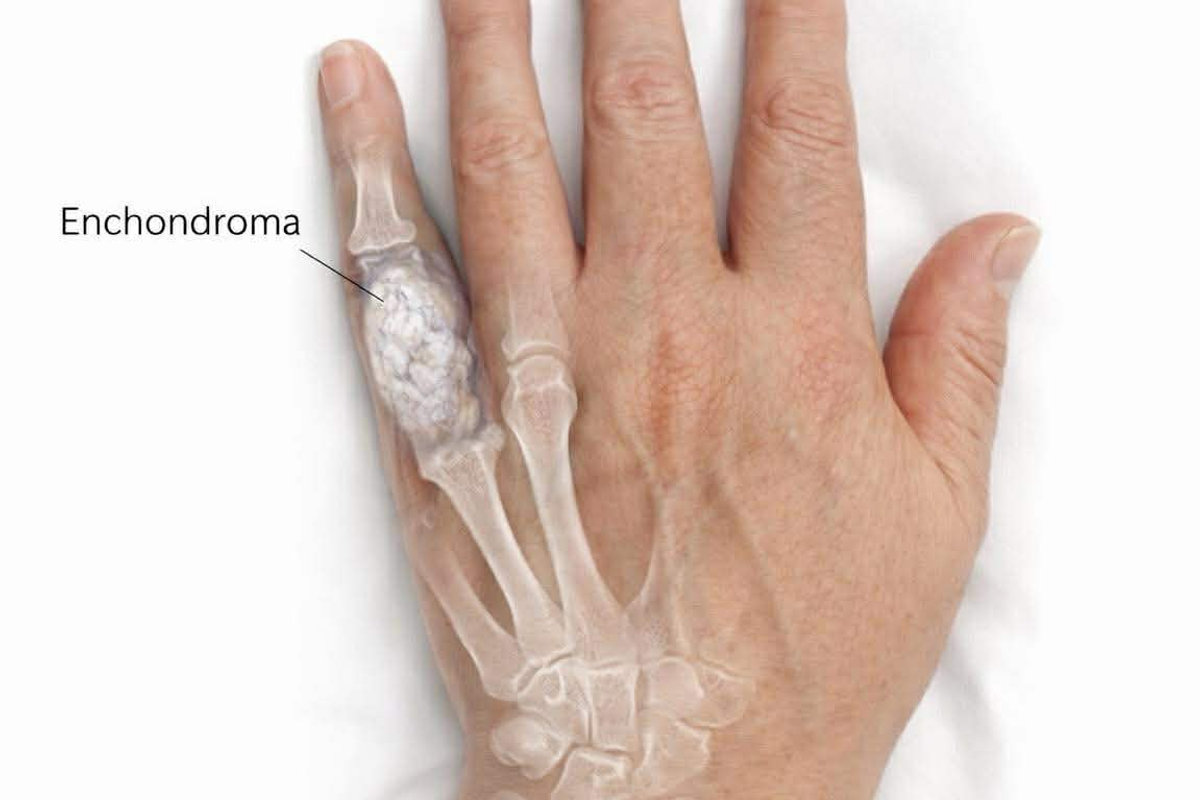
You bumped your hand lightly and your finger broke—or an X-ray for another reason revealed a hole or cyst-like area in one of your finger bones. In either case, the most likely diagnosis is an enchondroma—the most common primary bone tumor of the hand.
What Is an Enchondroma of the Hand?
An enchondroma is a benign (non-cancerous) cartilage tumor that develops inside bone. In the hand, enchondromas most commonly occur in the proximal phalanges (the finger bone closest to the palm) and metacarpals. They are composed of mature hyaline cartilage and typically grow slowly, expanding within the bone and weakening it from the inside.
How Are They Discovered?
- Pathologic fracture: The weakened bone breaks with minimal force. This is the most common presentation—a fracture from a minor injury that seems disproportionate to the force involved.
- Incidental finding: Discovered on X-ray taken for another reason (a different injury, arthritis evaluation, etc.)
- Painless swelling: Gradual enlargement of the finger as the tumor expands the bone
Diagnosis
X-rays show a characteristic appearance: a well-defined, lucent (dark) area within the bone, sometimes with stippled calcification. The cortex (outer shell of bone) may be thinned or expanded. MRI can provide additional detail if needed, but the diagnosis is usually straightforward from X-rays alone.
Treatment
INCIDENTALLY FOUND ENCHONDROMA (NO FRACTURE)
If the enchondroma is asymptomatic and the bone is intact, observation with periodic X-rays is often appropriate. Surgery is considered if the tumor is large enough to pose a significant fracture risk.
ENCHONDROMA WITH PATHOLOGIC FRACTURE
The fracture is allowed to heal first (typically 3–4 weeks in a splint), and then the tumor is treated surgically. The procedure involves curettage (scraping out the tumor from inside the bone) followed by bone grafting to fill the defect. I use the bone graft to provide structural support and promote new bone formation.
Recovery
- If fracture present: Fracture healing takes 3–4 weeks before surgery
- After surgery: Splint protection for 4–6 weeks
- Weeks 6–12: Progressive return to full activity as the bone graft incorporates
Bone Tumor Evaluation in Phoenix
If you’ve had a pathologic fracture or a bone lesion found on X-ray, proper evaluation by a hand surgeon ensures accurate diagnosis and appropriate treatment. I see patients from across Phoenix, Scottsdale, Mesa, Chandler, Gilbert, and the surrounding Valley areas.
Call (602) 258-4788 or visit toddrichardsmd.com to book an appointment with Dr. Todd Richards. Most insurance plans accepted. Same-week appointments often available.