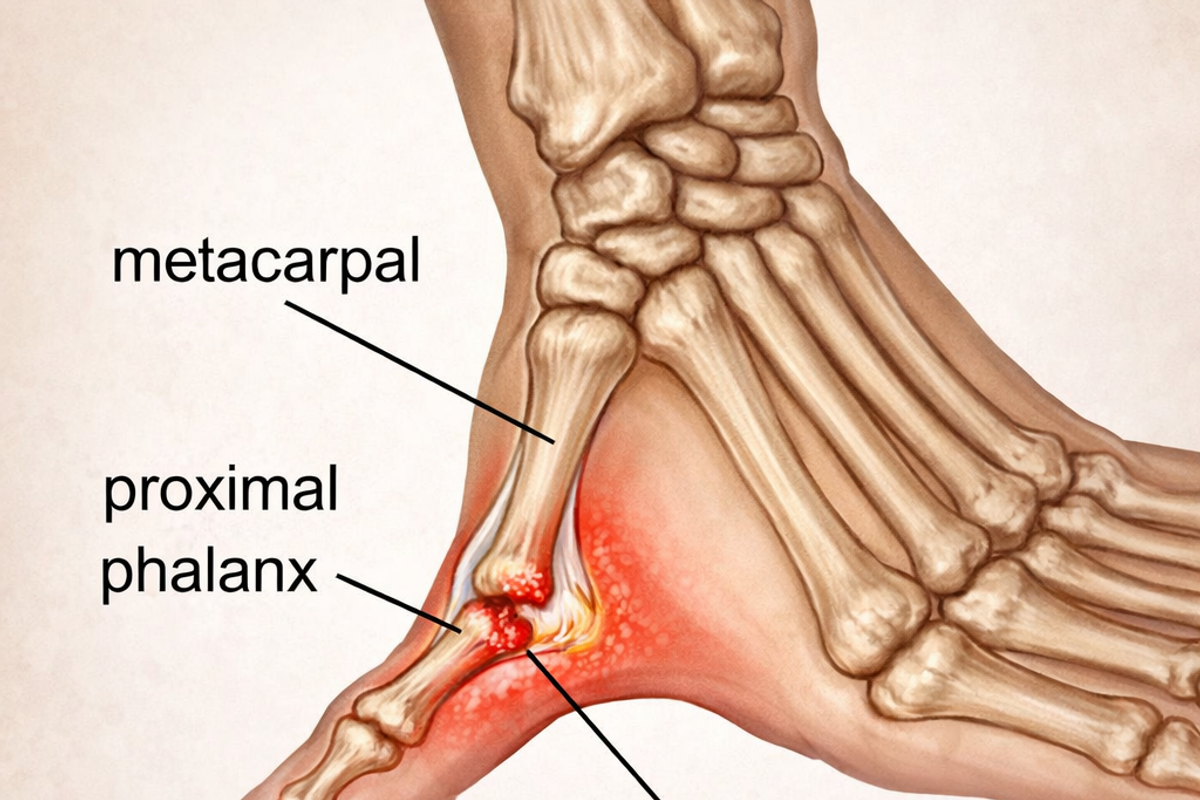
You fell on an outstretched hand, jammed your thumb during a sport, or got your thumb caught awkwardly—and now the thumb feels weak and unstable when you try to pinch or grip. You may have torn the ulnar collateral ligament (UCL) of your thumb, commonly known as skier's thumb or gamekeeper's thumb.
What Is the UCL and Why Does It Matter?
The ulnar collateral ligament stabilizes the metacarpophalangeal (MCP) joint of the thumb—the big knuckle at the base of the thumb. This ligament is critical for pinch strength and grip stability. When you pinch between your thumb and index finger, the UCL prevents the thumb from buckling outward. A torn UCL means an unstable, weak thumb that can't perform basic tasks like turning keys, opening jars, or gripping a pen.
How Does It Happen?
- Falling on an outstretched hand with the thumb extended (skiing with a pole in hand is the classic mechanism)
- Ball sports—catching or deflecting a ball that forces the thumb away from the hand
- Any forceful abduction (pulling away) of the thumb
- Gamekeeper's thumb refers to the chronic form, from repetitive stress (historically, Scottish gamekeepers breaking rabbit necks)
Symptoms
- Pain and swelling at the base of the thumb, on the side facing the index finger
- Bruising around the thumb MCP joint
- Weakness when pinching—inability to hold objects firmly between thumb and index finger
- A sense of instability or the thumb “giving way”
Why You Shouldn't Ignore It: The Stener Lesion
In a complete UCL tear, the torn ligament end can flip on top of a structure called the adductor aponeurosis, getting trapped in a position where it cannot heal back to bone. This is called a Stener lesion, and it occurs in the majority of complete UCL tears. A Stener lesion will not heal without surgery—no amount of splinting or rest will fix it—which is why proper evaluation is critical.
Diagnosis
I evaluate thumb stability by performing a stress test of the UCL, comparing laxity to your uninjured thumb. X-rays rule out fractures. An MRI or ultrasound can confirm a complete tear and identify a Stener lesion, helping guide the treatment decision.
Treatment
Partial UCL Tears
Partial tears (the ligament is stretched or partially torn but the joint is stable) can be treated with a thumb spica cast or splint for 4–6 weeks. Most heal well with immobilization alone.
Complete UCL Tears
Complete tears—especially with a Stener lesion—require surgical repair. I reattach the ligament to bone using a suture anchor. The procedure is outpatient, performed under regional anesthesia, and takes about 30–45 minutes. After surgery, the thumb is immobilized in a cast or splint for about 4–6 weeks, followed by hand therapy to restore motion and strength.
Recovery
- Weeks 1–6: Cast or splint protection
- Weeks 6–8: Begin gentle thumb motion, hand therapy
- Weeks 8–12: Progressive strengthening
- Months 3–4: Return to sports and full activity
Thumb Ligament Evaluation in Phoenix
If you've jammed your thumb and it's still weak, swollen, or unstable, don't assume it's “just a sprain.” A missed UCL tear can lead to chronic thumb instability and weakness. I provide expert evaluation and treatment for patients across the Phoenix metro—Scottsdale, Mesa, Chandler, Gilbert, Goodyear, Buckeye, and Fountain Hills.
Call (602) 258-4788 to book an appointment with Dr. Todd Richards. Most insurance plans accepted. Same-week appointments often available.