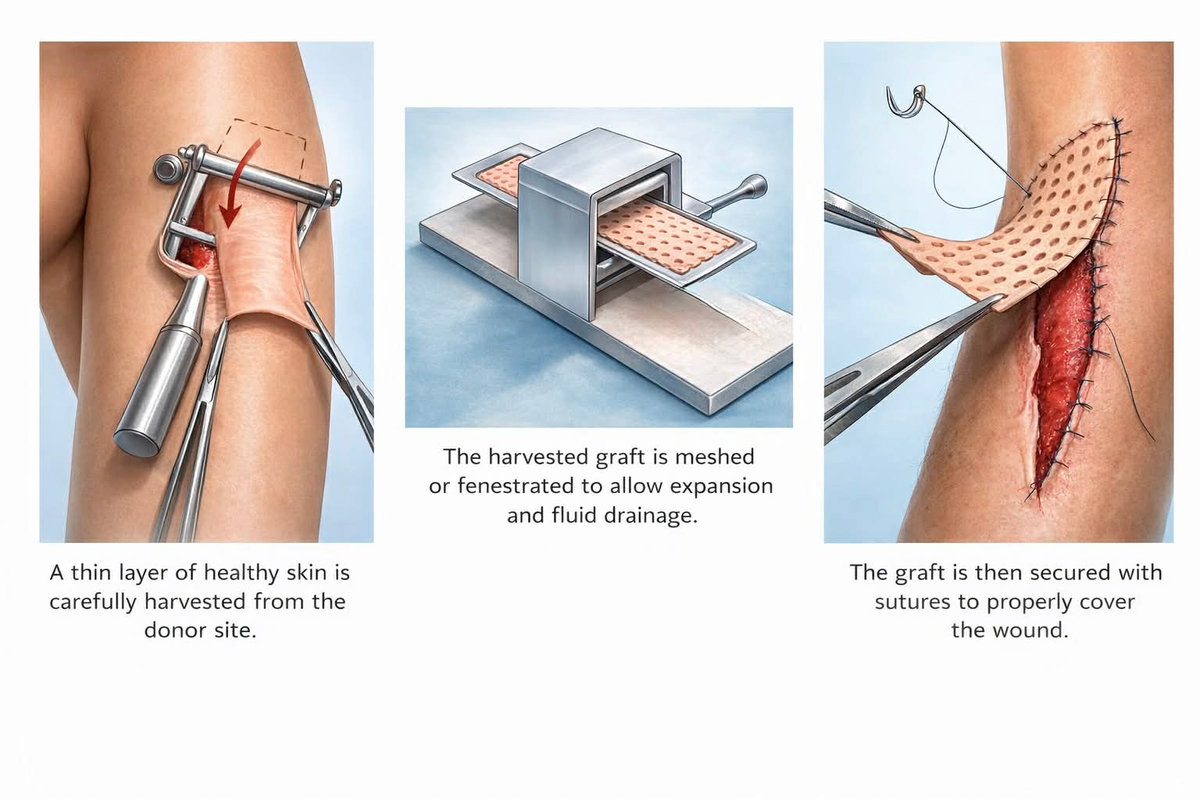
Severe hand injuries—from machinery accidents, burns, crush injuries, degloving injuries, or deep infections—sometimes result in significant skin loss that cannot be closed with stitches alone. In these cases, a skin graft is needed to provide coverage, protect underlying structures, and allow the hand to heal properly.
As a fellowship-trained hand surgeon in Phoenix, I perform skin grafting procedures for patients with complex hand wounds, and I want you to understand what the process involves.
When Is a Skin Graft Needed?
A skin graft may be necessary when:
- A wound is too large to close directly with sutures
- Skin has been lost due to trauma, burns, or infection
- Scar contracture is releasing and a graft is needed to fill the resulting defect
- Excisional debridement of infected or damaged tissue creates a wound that needs coverage in preparation for skin grafting
Types of Skin Grafts
SPLIT-THICKNESS SKIN GRAFT (STSG)
This involves taking a thin layer of skin (epidermis and part of the dermis) from a donor site—usually the thigh, upper arm, or forearm. The donor site heals on its own, similar to a road rash. STSGs are commonly used for larger wounds and are reliable in terms of graft survival.
FULL-THICKNESS SKIN GRAFT (FTSG)
This takes the entire thickness of the skin from a donor site, which is then closed with sutures. FTSGs provide better color match, texture, and durability. They’re preferred for smaller wounds on the hand and fingers where cosmetic appearance and durability matter most. Common donor sites include the wrist crease, inner arm, or groin crease.
The Skin Grafting Procedure
Skin grafting for hand injuries typically involves two stages:
STAGE 1: WOUND PREPARATION
Before a graft can be placed, the wound bed must be clean, healthy, and free of dead tissue. This often requires excisional debridement in preparation for skin grafting—the surgical removal of all nonviable tissue until a healthy, bleeding wound bed is achieved. Sometimes multiple debridements over several days are needed.
STAGE 2: GRAFT PLACEMENT
The skin graft is harvested from the donor site, tailored to fit the wound precisely, and secured with sutures or staples. A bolster dressing is applied to keep the graft in close contact with the wound bed—this is critical for graft survival, as the graft needs to establish blood supply from the underlying tissue.
Recovery After Skin Grafting
- Days 1–5: The hand is immobilized with a bolster dressing. Keep the hand elevated to reduce swelling.
- Days 5–7: First dressing change to check graft survival. Most grafts show healthy pink color at this point.
- Weeks 2–4: Gentle range of motion begins. The graft is healing and integrating.
- Weeks 4–8: Gradual return to activities. The graft continues to mature and soften over the following months.
- Months 3–12: Graft appearance continues to improve. Scar management with massage, silicone, and sun protection optimizes the final result.
Complex Hand Wound Care in Phoenix
If you’ve suffered a severe hand injury with skin loss, prompt evaluation by a hand surgeon gives you the best chance for recovery. I provide comprehensive wound management and skin grafting for patients from across Arizona—Phoenix, Scottsdale, Mesa, Chandler, Gilbert, Fountain Hills, Peoria, Goodyear, and Buckeye.
Call (602) 258-4788 or visit toddrichardsmd.com to book an appointment with Dr. Todd Richards. Most insurance plans accepted. Same-week appointments often available.